
Building Sustainable Agriculture and Supply Chains


Building Sustainable Agriculture and Supply Chains
Through technological innovation in farm-to-product development and collaboration with suppliers, we aim to build a sustainable global supply chain and expand our value creation domains.
Themes and Key Performance Indicators (KPIs)
Evolution of a unique world-class agricultural model
By perfecting high quality raw ingredients in collaboration with producers and strengthening relationships of coexistence and co-prosperity, ITO EN aims to contribute to the stable procurement of high quality raw ingredients and the development of sustainable agriculture.
The Tea-Producing Region Development Project
As a company deeply involved in agriculture, ITO EN launched the Tea-Producing Region Development Project in 1976 to achieve both the stable procurement of safe, secure and high quality green tea raw ingredients and solutions to the issues facing Japanese agriculture. This project consists of two different initiatives: cultivation under contract, whereby we purchase all tea leaves produced by contracted local tea farmers, and the new tea farms business, which involves creating large tea farms from abandoned farmland.

Contract farming since April 1976
ITO EN has contracted local tea farmers produce tea leaves used in tea bags and other leaf products, and in beverage products such as Oi Ocha, and purchases all of them.
New tea farms business since January 2001
ITO EN supports local business operators in leading the creation of large-scale tea farms from dilapidated farmland in cooperation with local governments. We comprehensively provide technology and expertise related to the production of tea leaves and purchase the total volume of tea leaves produced exclusively for the Oi Ocha brand.
Support provided and outcomes in Tea-Producing Region Development Project (in Japan)
In the new tea farms business, members of our Agricultural Technology Department have been involved in providing technical guidance, going to tea farms and factories in each tea producing region and providing agricultural production corporations and tea farmers with technology and expertise about tea production and cultivation techniques. One hundred percent of the tea leaves produced in the Tea-Producing Region Development Project are used in products(*), in principle, and this is an important project for ITO EN's procurement of raw ingredients.
(*) Tea drinks under the Oi Ocha brand, etc.Tea products such as Oi Ocha Green Tea Tea Bags, Oi Ocha Premium Tea Bags Green Tea with Uji Matcha, One Pot Green Tea with Matcha Tea Bags, etc.
Tea-Producing Region Development Project (new tea farms business) in Australia
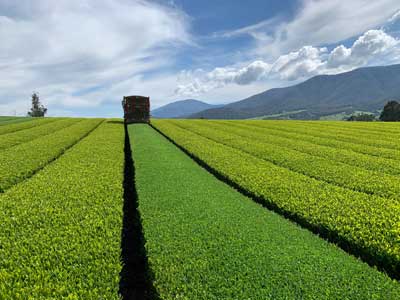 Believing we needed to ensure a stable supply of good quality tea to become a "Global Tea Company," we established ITO EN AUSTRALIA PTY. LIMITED in 1994 and launched the Tea-Producing Region Development Project (new tea farms business) in Victoria State, Australia, where the seasons are precisely opposite to Japan and the climate is similar. Like ITO EN in Japan, ITO EN AUSTRALIA PTY. LIMITED works with tea producers to integrate innovative technologies into the cultivation of tea and its employees visit production sites on a regular basis to build relationships of trust. In 2004, we built a crude tea factory and began full-scale production of crude tea. The crude tea produced at this factory is mainly used as a raw ingredient for ITO EN's Food for Specified Health Uses and global brand products.
In a new initiative, we also invested in the construction of a factory for the production of green tea tea bags, which went into operation from 2020. This factory manufactures MATCHA GREEN TEA "TRADITIONAL" (AUSTRALIAN GROWN LEAVES) tea bags for the local market, enabling us to respond to the green tea and matcha boom in Australia. Through this initiative, we will realize end-to-end production (tea cultivation, tea processing and tea product manufacturing) in Australia, meeting the requirements of the Australian Made, Australian Grown (AMAG) Campaign which promotes genuinely Australian locally grown foods, and seeking to contribute to the regional economy.
We will continue aiming to ensure the stable supply of tea all year round to meet growing demand for green tea beverages in the future.
Technical Development to Reduce the Use of Agrochemicals and for Organic Farming
Anticipating that demand in overseas markets will continue to rise, we are developing technologies to reduce the use of agrochemicals and for organization farming. We have started using nitrogen components contained in used tea leaves instead of nitrogen fertilizers that are necessary for growing tea leaves. The used tea leaves generated by outsourced plants during the manufacturing of beverage products are composted for use in the contracted production areas, thereby facilitating recycling-oriented farming.
We will also use an agrochemical-free, steam-operated machine to control pests and eliminate weeds. In this way, we contribute to environmentally friendly tea farming and the expansion of exports of Japanese tea.


Product quality and safety through GAP certification
ITO EN implements initiatives to acquire, maintain, and use GAP certification* as part of the Tea-Producing Region Development Project. We encourage the agricultural corporations and contract farmers which supply us with raw ingredients to acquire GAP certification, which is a standard for ensuring the safe production of food and protection of the environment, and all of these corporations and farmers obtained the certification in the Tea-Producing Region Development Project (as of the end of April 2024). The tea leaves produced by farms that have acquired GAP certification are used as the raw ingredients of Oi Ocha Green Tea and other products. We are committed to ensure the safety and security of our products.
(*)Certification granted to farms that engage in food safety and environmental conservation initiatives. In addition to the Global GAP international standard, other schemes include JGAP and ASIAGAP, which are granted by the Japan GAP Foundation. GAP certification here refers to farms that have obtained one of these three certifications.Pursuit of product safety and quality and reduction of environmental impact
As we handle food products, the ITO EN Group recognizes quality and safety as the most important aspects of our responsibility to our customers. We have established a strict quality control system from product design, raw ingredients and packaging materials to manufacture and distribution, by which we ensure product safety.
Reduction of environmental impact throughout the product lifecycle
ITO EN works to minimize environmental impact throughout the product life cycle.
Initiatives to improve customer satisfaction
In FY2009, ITO EN pledged to achieve voluntary conformity with the ISO10002 standard (an international standard for complaint handling management system). This standard requires companies to work continuously to make improvements in their various activities, and to create and operate a PDCA cycle-based complaint handling framework in order to achieve greater customer satisfaction. In accordance with the Basic Policy for Customer Satisfaction, ITO EN improves customer satisfaction by actively utilizing customer feedback in corporate management to help it develop better products and improve sales practices and by putting its management principle of Always Putting the Customer First into practice.
Basic Policy for Customer SatisfactionStructure for promoting improvement in customer satisfaction

Building a sustainable supply chain
Supply chain management
Based on the ITO EN Group's established policies, including the Human Rights Policy, Fundamental Supplier Policy, Procurement Policy and Quality Policy, the Group aims to build a responsible supply system that is both socially and environmentally conscious in collaboration with manufacturing contractors and related parties.
We are committed to enhancing the entire supply chain. We regularly evaluate suppliers using a questionnaire survey and share best practice at meetings with suppliers to address a range of challenges, including the pursuit of quality, safety and peace of mind, legal compliance, fairness in procurement and consideration for human rights, labor and the environment. When we start doing business with new suppliers, we explain our policies and guidelines, carry out onsite audit where necessary and verify the status of suppliers' activities.
In our quality management, we are working to provide safe and reliable products, comply with applicable laws and ordinances, and ensure safety of products utilizing international standards. Our domestic beverage and leaf manufacturing factories have acquired the ISO 9001 international quality management and quality assurance certification and the FSSC 22000 international food safety certification. We have established quality control systems and operate them in accordance with relevant rules and guidelines.
Our products are only manufactured in factories that satisfy ITO EN's quality management standards, and we thoroughly ensure safety and security in the manufacture of our products by carrying out regular factory audits and holding regular quality assurance meetings with suppliers.
In the area of logistics, we are promoting white logistics to consistently deliver safe and secure products to our customers. We work with our outsourcing partner companies to build an efficient logistics system that addresses social and environmental issues. We conduct regular assessments and audits of our outsourcing partners using transportation and storage checklists prepared by ITO EN and hold meetings with them to share information. The ITO EN Group ensures safety and security throughout the entire process from crude tea procurement to manufacturing and logistics. The Group works with the outsourcing partners to establish sustainable supply chain management practices.
In quality control, we strive to provide safe and reliable products, comply with laws and regulations, and ensure product safety by utilizing international standards. We have acquired international certifications such as ISO9001, a quality control and quality assurance standard, and FSSC22000, a food safety standard, at our domestic drink and leaf manufacturing plants, and have established and are operating a quality control system in line with related regulations and guidelines. Products are manufactured at factories that meet ITO EN's quality control standards, and regular factory audits and quality meetings with suppliers are conducted to ensure safe and secure products. We are also promoting thorough quality and safety management at our overseas manufacturing plants, which are certified internationally or equivalent to international certification.
In the area of logistics, we are promoting white logistics to consistently deliver safe and secure products to our customers. We work with our outsourcing partner companies to build an efficient logistics system that addresses social and environmental issues. We conduct regular assessments and audits of our outsourcing partners using transportation and storage checklists prepared by ITO EN and hold meetings with them to share information. The ITO EN Group ensures safety and security throughout the entire process from crude tea procurement to manufacturing and logistics. The Group works with the outsourcing partners to establish sustainable supply chain management practices.
Communication with suppliers

We hold regular quality meetings with suppliers to improve quality and ensure the creation of safe and secure products. At the quality meeting, we disseminate the ITO EN Group's material issues and related policies, such as the ITO EN Group Human Rights Policy, the ITO EN Group Fundamental Supplier Policy, and the ITO EN Group Environmental Policy, explain environmental issues such as climate change and water resources, and social issues such as human rights and occupational safety and health, and share good practice of addressing issues. We also ask our suppliers to report environment-related data such as GHG emissions and water consumption related to the manufacture of our products, and we encourage them to manage their progress toward achieving the ITO EN Group Medium- to Long-term Environmental Goals and to work to reduce their environmental impact.
In addition, we are working in cooperation to solve social and environmental issues, such as conducting supplier surveys that incorporate environmental and human rights items and working to conserve water sources near outsourced manufacturing factories.
Improving logistics efficiency
To deliver safe and reliable products consistently, we promote initiatives to enhance logistics efficiency. Through these efforts, we aim to reduce environmental impact, ensure a stable supply of products, and help address the challenges the logistics sector is facing.
- Block production and logistics system
- Under our block production and logistics system, the country is divided into several regional blocks, with products manufactured at the plants best suited to each area and supplied to neighboring regions. This approach shortens transportation distances, reduces CO2 emissions and logistics costs, and helps diversify risks in the event of a natural disaster.
- Relay transportation
- To address long working hours associated with long-distance transport, we promote relay transportation and are restructuring our logistics framework. This system supports the stable supply of products while improving working conditions by enabling drivers to return home on the same day.
- Collaborative transportation
- We work with partners across industries and sectors to develop more efficient logistics systems.
- Promoting the modal shift and strengthening transport capabilities using railways and ferries
- Improving loading efficiency and promoting standardized pallet practices