
Material Issues


Recognizing changes in the external environment and social issues, the ITO EN Group identified seven material issues in 2022, which were evaluated both in terms of their importance to the ITO EN Group and their importance to our stakeholders. Since then, rapid changes have occurred, including the widespread impact of climate change, disruptions in global supply chains, the emergence of human rights issues, and a growing interest in well-being.
We have reviewed our material issues (including key themes and KPIs) in light of our Medium- Term Management Plan(FYE4/2025-FYE4/2029), which sets these changes and globalization as our growth strategy. As a Health Creation Company, we will create value that contributes to the three types of health—mental and physical health, the health of society, and the health of the planet—through “Achieving Well-being through Eating Habits,” “Building Sustainable Agriculture and Supply Chains,” “Health of the Planet,” “Co-creation and Deepening Ties with Local Communities,” and strengthen our management foundation through “Respect for Human Rights,” “Diverse Human Assets and Active Roles for All,” and “Group Governance.” These are our material issues , and we have identified them(March 2025).
The entire ITO EN Group will work on the Medium- Term Management Plan and material issues to promote sustainability management.
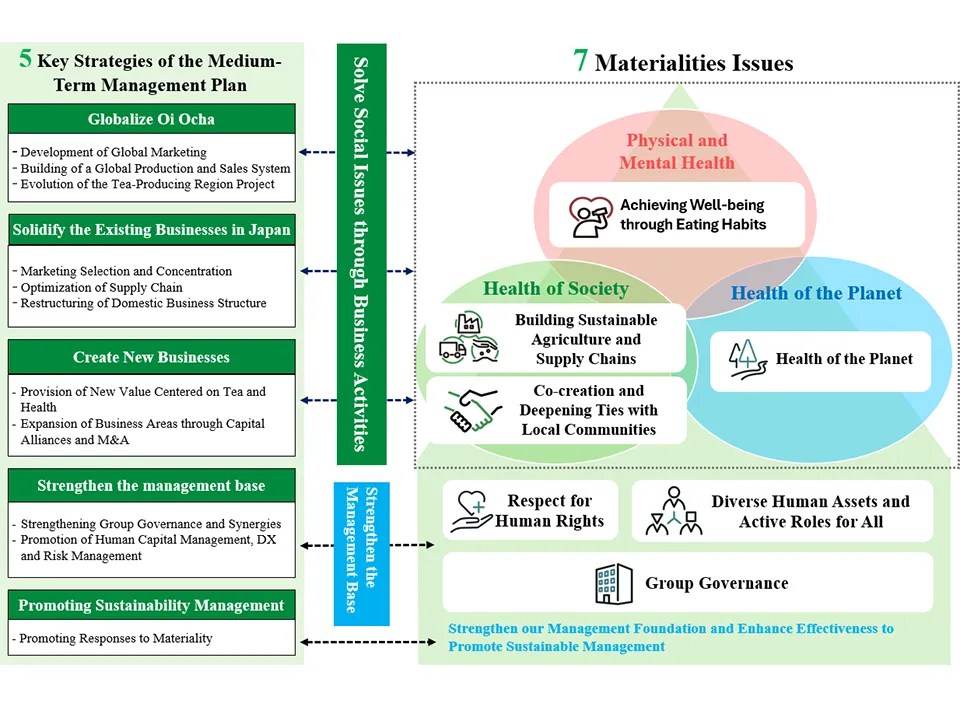
Seven Material Issues

Achieving Well-being
through Eating Habits

Building Sustainable
Agriculture and Supply Chains

Health of the Planet

Co-creation and Deepening
Ties with Local Communities

Respect for Human
Rights

Diverse Human Assets and
Active Roles for All

Group Governance
-
Achieving Well-being through Eating Habits
We aim to create and spread new eating habits that contribute to the well-being of people and society through research on ingredients, the taste and healthiness of our products, and hospitality.
-
Building Sustainable Agriculture and Supply Chains
Through technological innovation in farm-to-product development and collaboration with suppliers, we aim to build a sustainable global supply chain and expand our value creation domains.
-
Health of the Planet
We will work to solve environmental issues such as decarbonization and resource recycling through our business activities and create shared value with diverse stakeholders.
-
Co-creation and Deepening Ties with Local Communities
We will contribute to solving local and community issues, providing new value and creating business opportunities.
-
Respect for Human Rights
We will strive to minimize human rights risks throughout our global supply chain and earn the trust of our stakeholders.
-
Diverse Human Assets and Active Roles for All
We will build an organization in which diverse human resources “grow independently” and “continue to take on challenges toward our vision,” and develop and expand human resources who will be active in the priority areas of our business strategy.
-
Group Governance
Against the backdrop of the impact on management from changes in the external environment, including demographics, laws and regulations, conflicts, the importance of sustainability, and information security, we will develop a governance structure to minimize risks and maximize opportunities for the entire group.
Material Issues Identification Process
1. Identification of social issues
From the perspective of the changing external environment, the demands and expectations of society, and key customer issues, we identified social issues by referring to international disclosure standards, ESG evaluation criteria, and the SDGs.
* Disclosure standards referred to: GRI Standards, SASB Standards, ESG evaluations (FTSE, MSCI),CDP, SDGs, ISO 26000.
2. Importance / materiality evaluation
We evaluated the material issues candidates by adopting a double material issues approach, which maps the extracted social issues from both the perspective of their importance for stakeholders and their importance for the sustainable growth of the ITO EN Group. We evaluated the material issues candidates by conducting surveys of external experts, investors, outside directors, directors and executive officers of Group companies, and department heads.

3. Stakeholder dialogues
We held stakeholder dialogues with management and external experts to gather opinions on points for review, management issues, and expectations for the Ito En Group regarding material issues candidates identified through questionnaire surveys and other means.
4. Identification of material issues
Through the above process, the Board of Directors deliberated, identified material issues and priority themes to be addressed as management issues, and specified the key strategies of Medium- Term Management Plan.
Seven Material Issues and Indicators (KPIs)
We have established key themes and evaluation indicators (KPIs) for materiality to concretize the key strategies of our Medium- Term Management Plan, and we manage and evaluate them using the PDCA cycle. We plan to review the indicators (KPIs) regularly in accordance with the status of our initiatives.
| Material issues | Priority Themes | Main Initiatives and KPIs | Contributing SDGs |
|---|---|---|---|
| Achieving Well-being through Eating Habits | Providing drinking opportunities tailored to diversifying lifestyles and contributing to physical and mental well-being |
Visualize the contribution to well-being by materials (green tea, matcha, coffee, etc.) by deepening research on industry-government-academia collaboration.
|
|
|
Dissemination of domestic and overseas research results and promotion of efforts toward social implementation
|
|||
|
Expanding the taste and healthiness of unsweetened tea and unsweetened products derived from ingredients as a new value and new beverage option overseas
|
|||
|
Promoting social connections through nutrition education activities, production area experiences, coffee, etc.
|
|||
| Building Sustainable Agriculture and Supply Chains | Evolution of the “The Tea-Producing Region Development Project” in collaboration with tea grower |
The Tea-Producing Region Development Project expansion of development area
|
|
|
Promotion of sustainable agriculture such as reduced use of pesticides and organic farming and increased production of overseas standard raw ingredients
|
|||
|
Expansion of overseas local production through evolution of technology and know-how
|
|||
| Sustainable sourcing of raw ingredients (tea leaves, etc.) |
Sustainable sourcing of raw materials (tea leaves, coffee, vegetable juices)
|
|
|
| Deepen supplier engagement and pursue safe and secure quality |
Obtained international food safety certification for domestic manufacturing plants (beverage and leaf)
|
|
|
|
Thorough quality and safety management at overseas manufacturing plants that are certified internationally or equivalent to international certification.
|
|||
|
Conduct supplier evaluations in response to changes in the environment (domestic and overseas) |
|||
|
Continue to hold domestic quality meetings, hold global quality meetings
|
|||
|
Holding “environmental quality meetings” with contract manufacturing factories
|
|||
| Building a sustainable logistics system |
Improving logistics efficiency
|
|
|
|
Promote modal shift and strengthen transportation and delivery capabilities through the use of railroads and ferries
|
|||
|
Expansion of other cooperative businesses
|
|||
| Health of the Planet | Response to climate change |
GHG emission reduction rate
|
|
|
Use of renewable energy*1
|
|||
|
Electric vehicles: EVs, HVs, PHVs, and FCVs with hydrogen*1
|
|||
| Sustainable containers and packaging |
Percentage ratio of recycled materials used for all PET bottle products
|
|
|
|
Promote 3Rs (Recycle, Reduce, Replace & Reuse) in packaging, sales promotion materials, and materials, and switch to environmentally friendly materials |
|||
| Water resources |
Reduction water use consumption during beverage production
|
|
|
|
Implementation of water source conservation activities at beverage manufacturing factory.
|
|||
| Natural capital and biodiversity conservation |
Study of global indicators based on TNFD recommendations and promotion of sustainable agriculture |
|
|
| Resource recycling/promoting waste reduction |
Improvement of food recycling rate
|
|
|
|
Effective use of tea, barley and coffee grounds
|
|||
|
Tully’s Coffee Japan Promoting waste reduction
|
|||
|
Reduce use of plastics derived from fossil fuels
|
|||
| Co-creation and Deepening Ties with Local Communities | Creating business opportunities to solve social issues in each country and region |
Co-creation with stakeholders on food and health (obesity, overweight, nutritional balance, etc.) and social and environmental issues
|
|
| Collaboration with local communities and collaborators through business activities |
Dissemination of research results and promotion of social implementation initiatives aimed at solving health issues in local communities
|
||
|
Collaboration with local governments and stakeholders in each region, including Green Tea for Good “Make the World Beautiful with Tea”
|
|||
| Respect for Human Rights | Respect for human rights in the value chain |
Understand (identify and assess) human rights risks that may cause or contribute to human rights violations through ITO EN Group's businesses and services, and formulate a human rights due diligence plan by FY2025. |
|
|
Conduct human rights assessments of suppliers |
|||
|
Conduct human rights due diligence at raw material production areas and production sites
|
|||
|
Disseminate and expand the scope of the grievance mechanism |
|||
|
Conduct internal human rights awareness training
|
|||
| Co-creation and Deepening Ties with Local Communities |
Review and formulate key themes and KPIs by examining the human capital strategy linked to the management strategy during FY2025 (to be disclosed in FY2026) |
||
| Development and empowering of diverse human resources |
Employee engagement score
|
|
|
|
Female manager ratio
|
|||
|
Gender pay gap (regular full-time employees, male employees = 100)
|
|||
|
Percentage of male employees taking childcare leave
|
|||
| Promoting health and productivity management |
Maintain Health and Productivity Management Organization (White 500) certification |
|
|
| Group Governance | Establishment of group governance structure |
Develop the next generation of management personnel (directors, executive officers, and managers) |
|
|
Development of training plans for managers and CXOs of major ITO EN Group companies |
|||
|
Promoting efforts to nurture the younger generation with a view to future management personnel |
|||
| Strengthening Group risk management |
Identification of management risks and consideration of countermeasures |
||
|
Forecast the future, identify business opportunities, and review strategies |
|||
| Information security/protection of customer privacy |
Establishment of information security governance structure
|
||
| Enhanced stakeholder engagement |
Conduct stakeholder dialogues to improve management
|
||


-
1. Applies to ITO EN, LTD. and its consolidated subsidiaries.
*FY2023 initiatives (material issues and KPIs prior to revision)